---
title: From JIT Access to JIT Governance
description: "“Just-in-time” is one of the most-used phrases in identity security. It’s on nearly every slide and in nearly every product description. So it’s worth asking a simple question: when we say “JIT,” what do we actually mean?"
image: https://blog.tuebora.com/hubfs/jit_governance_lifecycle_wheel_large.svg
---
[](https://tuebora.com/)
[](https://tuebora.com/)
[](https://tuebora.com/)
- Platform
[IVIP (Identity Visibility & Intelligence Platform) New The intelligence spine of Tuebora](https://tuebora.com/platform/ivip) [Tuebora Studio New The design plane for IAM - the "Cursor" for IAM](https://tuebora.com/platform/studio) [AI Agent Framework New Policy-bound AI agents that execute identity workflows with governance](https://tuebora.com/platform/ai-agent-framework) [Experience & Interaction Layer Role-based interfaces and conversational access for every stakeholder](https://tuebora.com/platform/experience-layer)
- Solutions
Core Governance
[Access Governance Unified requests, reviews, and controls with continuous monitoring](https://tuebora.com/solutions/access-governance) [Identity Lifecycle Management Automate joiner, mover, and leaver processes with policy-driven governance](https://tuebora.com/solutions/lifecycle-management) [Compliance & Audit Continuous compliance with automated evidence and real-time visibility](https://tuebora.com/solutions/compliance-audit)
Advanced & AI-Driven
[Non-Human & AI Identity Governance New Govern machine, application, and AI identities with full lifecycle control](https://tuebora.com/solutions/non-human-identity-governance) [AI Agent Governance New Policy-driven control for what AI agents can access, decide, and execute](https://tuebora.com/solutions/ai-agent-governance) [Conversational Access (AskTuebora) Request, approve, and manage access through natural language](https://tuebora.com/solutions/conversational-access)
- Resources
[Use Cases Real-world identity governance scenarios](https://tuebora.com/resources/use-cases) [Whitepapers In-depth technical insights and innovative approaches](https://tuebora.com/resources/whitepapers) [Blog Insights and thought leadership in AI-driven IGA](https://blog.tuebora.com/) [Documentation Comprehensive platform documentation and PDFs](https://tuebora.com/resources/docs)
- Customers
[Our Customers Leading enterprises that choose Tuebora for identity governance](https://tuebora.com/customers/our-customers) [Customer Portal Knowledge base, documentation, and support requests](https://support.tuebora.com/hc/en-us)
- Company
Company
[About Our mission, values, and what we believe about identity](https://tuebora.com/company/about) [Leadership Meet our founders, leadership team, and advisors](https://tuebora.com/company/leadership) [Careers Join the team building modern identity systems](https://tuebora.com/company/careers) [Life at Tuebora Culture and what it's like to work here](https://tuebora.com/company/life) [Contact Talk to sales, support, or our team](https://tuebora.com/company/contact)
Partners
[Our Partners Resellers, service providers, and global SIs partnering with Tuebora](https://tuebora.com/partners/our-partners) [Partner Program Earn commissions delivering Agent-Driven IGA to your clients](https://tuebora.com/partners/partner-program)
- [Editions](https://tuebora.com/pricing)
[Get a Demo](https://offers.tuebora.com/tuebora-iga-schedule-demo) [Request a POC](https://offers.tuebora.com/schedule-poc)
Tuebora Blog
# Insights & Blog
Welcome to the Tuebora blog. As pioneers in leveraging AI Agents for smarter, faster, and more adaptive identity management, we aim to empower businesses to secure their digital ecosystems with precision and efficiency. Here we strive to inform and inspire our readers with insights into the latest innovations, emerging trends, and transformative ideas in the IGA space. You'll discover how Tuebora not only anticipates industry shifts but also pioneers new concepts that challenge traditional approaches to identity governance. Let us guide you through the evolving landscape of IGA, where our expertise helps bridge the gap between complex challenges and practical, forward-thinking solutions.
[Get a Demo](https://offers.tuebora.com/tuebora-iga-schedule-demo)
[](https://blog.tuebora.com/from-jit-access-to-jit-governance)
## 18
### Aug
2026
### [From JIT Access to JIT Governance](https://blog.tuebora.com/from-jit-access-to-jit-governance)
[Sanjay Nadimpalli](https://blog.tuebora.com/author/sanjay-nadimpalli)
[0 Comments](https://blog.tuebora.com/from-jit-access-to-jit-governance#comments-listing)
[IAM](https://blog.tuebora.com/tag/iam), [Identity Governance](https://blog.tuebora.com/tag/identity-governance), [Orphaned Accounts](https://blog.tuebora.com/tag/orphaned-accounts), [Productivity](https://blog.tuebora.com/tag/productivity), [Digital Transformation](https://blog.tuebora.com/tag/digital-transformation), [asktuebora](https://blog.tuebora.com/tag/asktuebora), [Living Identity](https://blog.tuebora.com/tag/living-identity)
- [Tweet](https://twitter.com/share)
# From JIT Access to JIT Governance
#### Just-in-time” is a temporal pattern, not a provisioning feature. Here’s what happens when you apply it to the entire identity governance lifecycle - and why AI agents make it urgent
---
“Just-in-time” is one of the most-used phrases in identity security. It’s on nearly every slide and in nearly every product description. So it’s worth asking a simple question: **when we say “JIT,” what do we actually mean?** The answer is more revealing — and more limiting — than the shorthand suggests.
### The word “JIT” is used two ways
Across the industry, “just-in-time” tends to mean one of two things.
The first is **ephemeral privilege**. Instead of a standing admin account, you request elevation for a window — say, two hours on a particular host. A broker issues a short-lived credential, the session runs, and the credential is destroyed afterward. The point is to eliminate *standing* privilege: no persistent admin rights sitting around to be stolen or misused.
The second is **lazy provisioning**. On a user’s first single-sign-on login, the downstream account is created on the fly from identity attributes, rather than pre-staged. It’s convenient — but the account, once created, simply stays.
Both are genuinely useful. But notice what they have in common: **both stop at provisioning.** Ephemeral credentials are provisioning. Lazy account creation is provisioning. The entire “just-in-time” conversation has quietly become a conversation about *creating and destroying access*.
That’s understandable. Provisioning is the easiest primitive to point at — it’s physical. You can watch an account appear and disappear. But it is not the only primitive the pattern fits, and treating it as such leaves the most valuable version of the idea on the table.
### JIT is a pattern, not a feature
Strip away the provisioning framing and here’s what just-in-time actually is:
> A governance decision or action should exist **only at the moment of need**, be **driven by a real-time signal**, and leave **no standing state** behind.
Read that again and notice what’s *not* in it. Nothing about accounts. Nothing about credentials. It’s a statement about *timing* — replacing periodic, batch, and standing behavior with event-driven behavior. And once you see JIT as a timing pattern, you can apply it to every primitive in identity governance, not just the one where the conversation happened to start.
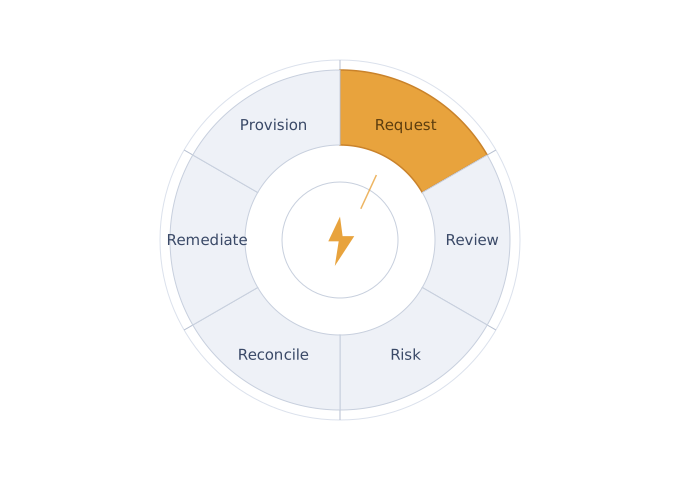
Most governance today is periodic or standing by default:
- **Access requests** happen when a user goes hunting through a catalog they don’t fully understand.
- **Certifications** happen quarterly, whether or not anything changed — a firehose of reviews on a calendar.
- **Risk scores** recompute overnight in a batch, so they can be stale for a day.
- **Reconciliation** runs as a full nightly sweep across every account, most of which didn’t move.
- **Remediation** waits for someone to open a ticket after the fact.
Every one of those is a candidate for JIT. Not “create the account faster” — but **make the governance decision exactly when it’s needed, triggered by a signal, and leave nothing standing.**
| Primitive | Periodic / standing today | Just-in-time |
| --- | --- | --- |
| **Request** | Browse a catalog | The right access is *recommended at the moment of need* |
| **Review** | Quarterly campaign | A single item is certified *because a risk signal fired* |
| **Risk** | Nightly recompute | Score recomputed *when a relevant change lands* |
| **Reconcile** | Full nightly sweep | Only the one account a signal says *drifted* |
| **Remediate** | Manual ticket | Signal → disable / step-up / revoke *automatically* |
| **Provision / de-provision** | Standing access + cleanup projects | Granted on a trigger, *expires intrinsically* |
That’s the difference between “JIT provisioning” and **JIT Governance.** One is a feature. The other is an operating model.
### AI agents make this urgent
If the reframe sounds abstract, AI agents make it concrete — because an AI agent is the purest just-in-time identity there is.
An agent **spins up for a task and should disappear after it.** It needs a **narrow scope for seconds to minutes**, not a standing entitlement. It behaves **non-deterministically** — doing things you didn’t pre-authorize — so governing its *actions* in real time matters more than it does for a predictable human role. And agents arrive **by the thousand**, far faster than any human population.
Now line that up against how governance usually works. You cannot hand a fleet of ephemeral agents *standing* access — that’s a standing-risk explosion. And you cannot run *quarterly campaigns* over identities that live for minutes; the review would fire long after the agent is gone. The periodic, standing model simply doesn’t fit.
Just-in-time governance does:
- **JIT grant** — the agent gets exactly the scope its current task needs, minted for that task.
- **JIT de-provision** — the grant expires when the task or session ends, intrinsically, not via a cleanup sweep.
- **JIT review** — the agent’s access and actions are certified when a risk signal fires, not on a calendar.
- **JIT remediation** — anomalous agent behavior triggers automatic step-up, revoke, or quarantine.
- **JIT risk recompute** — the agent is re-scored when its behavior or blast radius changes.
Governing AI agents is one of the defining identity problems of this moment. Just-in-time governance is the natural shape of the answer.
### “Governing JIT access” vs. making governance just-in-time
You’ll increasingly see the phrase *“just-in-time access governance”* — usually meaning *how you govern, and who owns, just-in-time access*. That’s a real and useful question. But notice it still bolts “just-in-time” to *access*: it’s governance *of* JIT access.
The idea here is the inverse. It’s not just governing just-in-time access — it’s making **governance itself** just-in-time. Not “who approves the two-hour elevation,” but “why is the *certification* still quarterly, the *risk score* still nightly, the *remediation* still a ticket?” Point the pattern at the governance lifecycle, not just at the access, and the scope changes entirely.
### The pieces already exist — the frame is the contribution
The encouraging part is that the industry is already building the components of this. There are emerging standards for **signal-driven session and access revocation**. There is a whole discipline — **threat detection and response for identity** — that is, in effect, signal-driven remediation. There is growing interest in **continuous, event-based certification**, and in **runtime authorization** that moves the decision to the point of use.
Each of these is real. Each is also, today, its own silo — a separate capability, standard, or team. The **pattern that connects them** is what we’re naming: every governance decision, made just-in-time, driven by real-time signals, with no standing state. That through-line — **JIT Governance** — is the contribution, not the two words.
### What a JIT governance engine actually requires
You can’t bolt this on. Applying JIT across the lifecycle takes an architecture built around a single loop: **signal in → governance action out.** Concretely, three things have to work together:
1. **A real-time signal source** — risk and behavior intelligence emitting events continuously, not a nightly batch.
2. **A reaction spine** — an event router that turns a signal into the *right* action against in-flight work: reassign a review, withdraw a stale request, escalate an item, re-score an identity, reconcile a single account.
3. **Governance primitives that are natively event-driven** — requests, reviews, risk, and reconciliation that can run *on a trigger*, not only on a schedule.
This is the architecture Tuebora is built around. Real-time intelligence emits the signals. An event-driven reaction engine consumes them and drives governance actions — reactively reassigning or withdrawing in-flight review items, escalating, and recomputing — the moment the underlying identity changes. Requests, reviews, and risk already run event-driven, not only on a calendar. The reactive machinery is easy to describe by its outputs — “it reassigns reviews,” “it withdraws requests” — but it’s really one thing: a just-in-time governance engine, ready for human and agent identities alike.
### The takeaway
Next time “JIT” comes up, ask the follow-up: *just-in-time what?* If the answer stops at provisioning, that’s the floor, not the ceiling. Just-in-time was never really about accounts. It’s about eliminating standing risk and calendar-driven busywork across the *entire* governance lifecycle — request, review, risk, reconcile, remediate, and, yes, provision — for humans and, increasingly, for the AI agents that make the old model impossible.
That’s JIT Governance. And it’s where identity security is heading, whether the category has named it yet or not.
*Ready to see governance that runs on signals instead of schedules? \[[Book a demo](https://offers.tuebora.com/tuebora-iga-schedule-demo)\]*
If you enjoyed this post, please consider [leaving a comment](https://blog.tuebora.com/from-jit-access-to-jit-governance#comments-listing) or [subscribing to the RSS feed](https://www.tuebora.com/blog/feed/) to have future articles delivered to your feed reader.
## Leave a Reply
### Feeds
### Popular Posts
### Archives
- [August 2026 (1)](https://blog.tuebora.com/archive/2026/08)
- [August 2025 (1)](https://blog.tuebora.com/archive/2025/08)
- [May 2025 (1)](https://blog.tuebora.com/archive/2025/05)
- [October 2024 (1)](https://blog.tuebora.com/archive/2024/10)
- [August 2024 (2)](https://blog.tuebora.com/archive/2024/08)
- [May 2024 (1)](https://blog.tuebora.com/archive/2024/05)
- [March 2024 (1)](https://blog.tuebora.com/archive/2024/03)
[](https://tuebora.com/)
Identity Intelligence. Executed.
Policy-driven, explainable identity governance with agent-based execution across your apps, cloud, and infrastructure.
[Get a Demo](https://offers.tuebora.com/tuebora-iga-schedule-demo) [Request a POC](https://offers.tuebora.com/schedule-poc)
#### Platform
- [IVIP](https://tuebora.com/platform/ivip)
- [Tuebora Studio](https://tuebora.com/platform/studio)
- [AI Agent Framework](https://tuebora.com/platform/ai-agent-framework)
- [Experience & Interaction Layer](https://tuebora.com/platform/experience-layer)
#### Solutions
- [Access Governance](https://tuebora.com/solutions/access-governance)
- [Identity Lifecycle Management](https://tuebora.com/solutions/lifecycle-management)
- [Compliance & Audit](https://tuebora.com/solutions/compliance-audit)
- [Non-Human & AI Identity Governance](https://tuebora.com/solutions/non-human-identity-governance)
- [AI Agent Governance](https://tuebora.com/solutions/ai-agent-governance)
- [Conversational Access](https://tuebora.com/solutions/conversational-access)
#### Resources
- [Use Cases](https://tuebora.com/resources/use-cases)
- [Whitepapers](https://tuebora.com/resources/whitepapers)
- [Blog](https://blog.tuebora.com/)
- [Documentation](https://tuebora.com/resources/docs)
#### Customers
- [Our Customers](https://tuebora.com/customers/our-customers)
- [Customer Portal](https://support.tuebora.com/hc/en-us)
#### Company
- [About](https://tuebora.com/company/about)
- [Leadership](https://tuebora.com/company/leadership)
- [Careers](https://tuebora.com/company/careers)
- [Life at Tuebora](https://tuebora.com/company/life)
- [Contact](https://tuebora.com/company/contact)
- [Our Partners](https://tuebora.com/partners/our-partners)
- [Partner Program](https://tuebora.com/partners/partner-program)
#### Editions
- [Editions](https://tuebora.com/pricing)
© 2026 Tuebora. All rights reserved.
[Docs](https://tuebora.com/resources/docs) [Privacy](https://tuebora.com/privacy)